
Coffee grind size: what to buy for your brewer
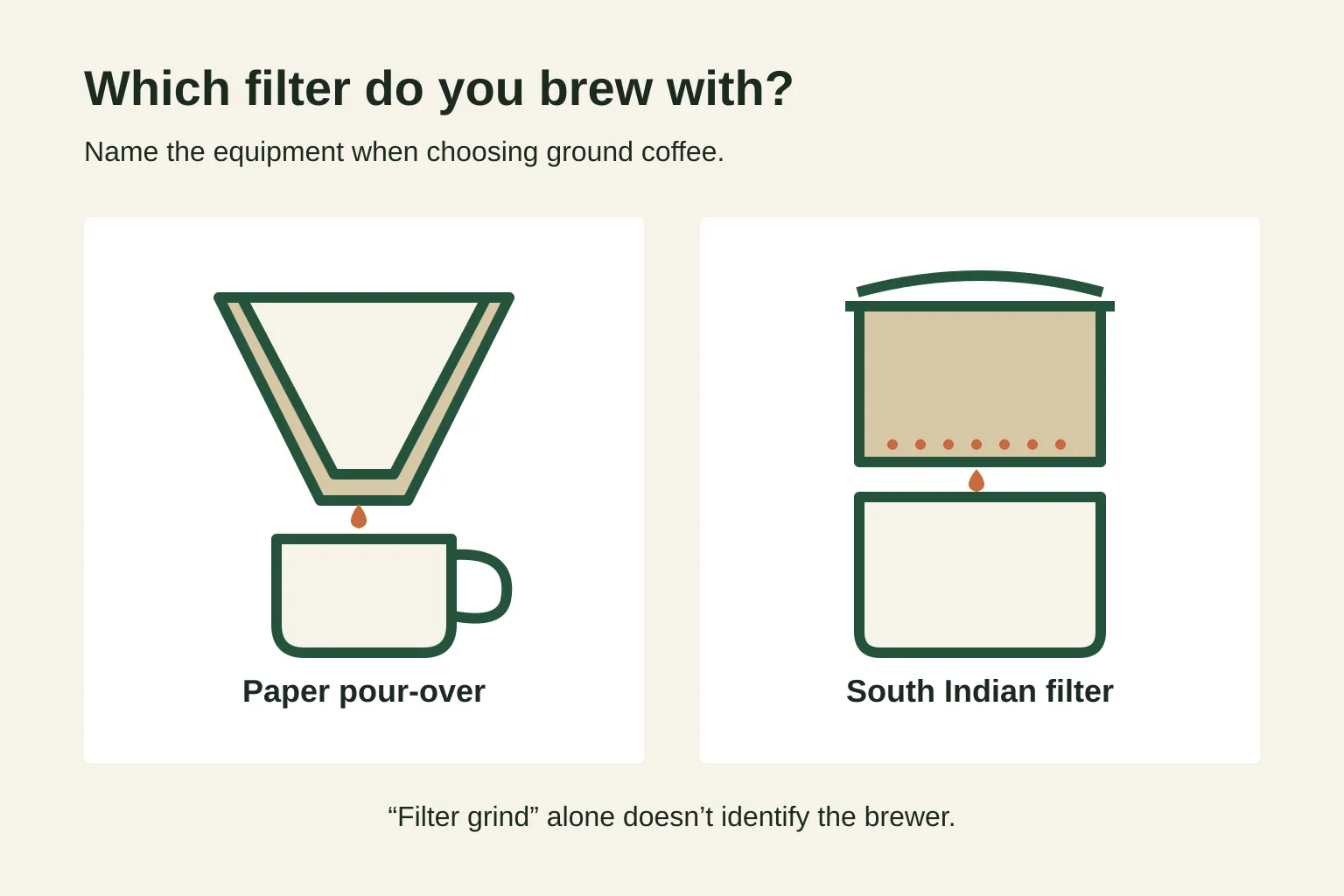
Choose coffee grind size by the brewer you own: coarse is a useful starting point for French press, medium for many paper filters, and a moka-specific grind coarser than espresso for a moka pot. For a South Indian filter, ask for that equipment by name rather than just “filter grind”; for espresso, specify your machine and basket. If you don't have a grinder, buy ground coffee, not whole beans.
Which coffee grind size should I buy?
Grind size means the size of the coffee particles, not how light or dark the beans are roasted. Use the table to choose a starting option, then check the seller's description against your equipment. These labels aren't universal settings.
| Your brewer | Starting option to ask for | Detail to give the seller |
|---|---|---|
| French press / cafetière | Coarse to medium-coarse | A metal-mesh French press, not a paper filter |
| Paper pour-over or drip machine | Medium; some pour-overs suit medium-fine | Brewer model, paper type and usual batch size |
| South Indian metal filter | A South Indian filter grind, often medium-fine to fine | Filter size, whether it uses a pressing disc, and whether you want pure coffee or a coffee–chicory blend |
| Moka pot | Moka-specific grind, coarser than espresso | Pot model and size |
| AeroPress | Medium-fine for the maker's standard approach | Model and recipe; longer-steep recipes can use other grinds |
| Espresso machine | Espresso grind matched to the basket | Machine model and whether the basket is single-wall or pressurised / dual-wall |
AeroPress's grind FAQ places its usual starting grind between drip and espresso. Bialetti's moka guidance specifies a grind coarser than espresso and an untamped basket. Follow your brewer's manual where it gives a more specific instruction.
“Filter grind” can mean two different things
A paper pour-over drains through filter paper. A South Indian filter drains through a perforated metal chamber to make decoction. A bag labelled “filter” doesn't tell you which of these the seller means.
Look for the equipment name in the product description. If it isn't there, ask before buying. For a South Indian filter, check the ingredients separately: grind tells you particle size, not whether chicory is included. Pure coffee and coffee–chicory blends needn't drain or taste alike.
The metal filter's holes, coffee-bed depth and pressing disc also affect drainage. Skiá's South Indian filter instructions call for levelling the coffee without packing it down hard. A stalled drip isn't automatically proof that you bought the wrong grind.
Send the seller your brewer, not a grinder number
Grinder numbers don't transfer reliably between models. “Setting 12” is less useful than the equipment name unless both people use the same grinder and calibration.
Before choosing a pre-ground option:
- Find your brewer's name or model. For espresso, check the basket type in the manual.
- Match it to a named brewing option, not just “fine” or “filter”.
- If the fit is unclear, send the seller the model, usual batch and what went wrong with your previous coffee, if anything.
Here is an example enquiry you can adapt:
I use a small South Indian stainless-steel filter with a pressing disc and make decoction for two milk coffees. I don't own a grinder. Is your filter grind intended for this brewer or for a paper pour-over? I'd like pure coffee without chicory. My previous coffee barely dripped even after I cleaned the holes and levelled the bed without packing it.
For espresso, replace the filter details with the machine and basket type. A pressurised basket may accommodate pre-ground coffee differently from a single-wall basket. Single-wall espresso usually benefits from an espresso-capable grinder because the grind needs adjustment as the coffee and flow change.
What if I've already bought the wrong grind?
Whole beans, no grinder: ask whether the seller or a nearby roaster can grind them for your equipment. Whole beans can't go straight into a normal French press, filter or moka basket.
Medium grounds in a French press: try them before replacing the bag. Medium can work with a suitable steep-and-settle method, but a metal mesh may let more sediment through. Pour gently and leave the last sediment behind; don't force a resistant plunger.
AeroPress is hard to press: press gently rather than pushing harder. AeroPress's troubleshooting advice explains that very small particles can block flow and that hard pressing compacts the bed. A coarser grind may help on the next purchase.
Espresso-fine grounds for a moka pot: don't pack them into the basket to make them work. Choose moka-suitable grounds instead, keep the safety valve unobstructed and follow the pot's manual. If the pot fails to flow, stop heating and let it cool before checking it.
With pre-ground coffee, you can't make the particles coarser again. Keep a note of the brewer, dose, water, flow and taste so your next purchase is a better match. Bitterness alone doesn't prove the grind is too fine: roast, heat and uneven brewing can also contribute.
Put the grind choice to work
For brewing steps and starting recipes, use the brewing methods and grind reference. For a French press or pour-over batch, the free coffee-to-water calculator helps you set the dose while keeping water steady; it isn't an espresso-yield or decoction-and-milk calculator.
Ghatside's roast-and-grind preference guide explains the choice language, and the monthly coffee offer sets out the proposed bag and ordering details. Coffee purchases aren't open yet; the preference guide's labels aren't a confirmed fulfilment menu.